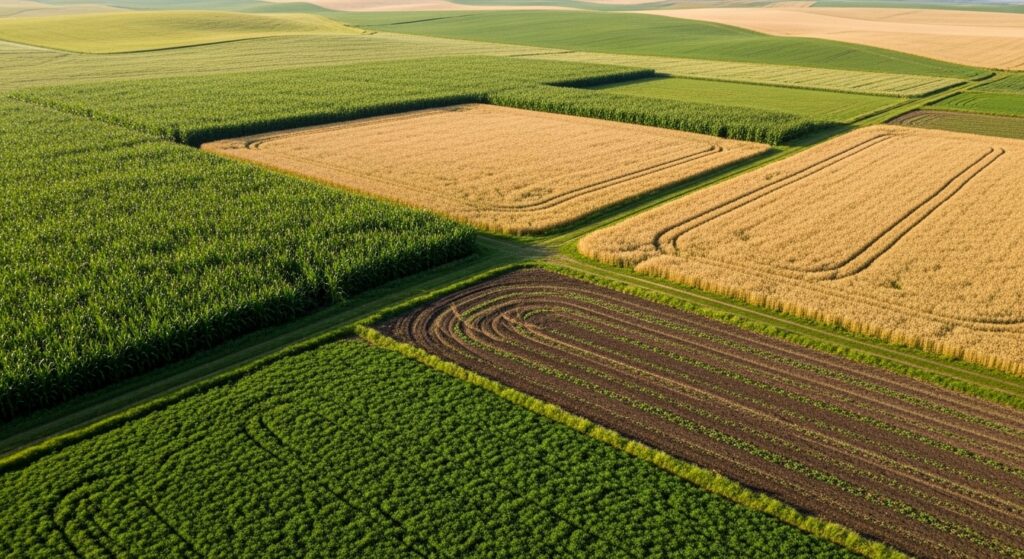
Crop rotation is one of the oldest and most effective agricultural practices—yet it remains one of the most valuable strategies in modern sustainable farming. By growing different crops on the same land in sequential seasons, farmers can preserve soil health, reduce pests, and significantly boost productivity.
Whether you are a small farmer, greenhouse grower, or managing large-scale agriculture, crop rotation can transform the long-term fertility of your land.
🌱 What Is Crop Rotation?
Crop rotation is the practice of planting different crops in a planned sequence on the same field over multiple seasons or years.
Example Cycle:
- Legume (fixes nitrogen)
- Leafy vegetable
- Root crop
- Fruit-bearing crop
This systematic cycle prevents nutrient depletion and reduces pest buildup.
⭐ Benefits of Crop Rotation
1. Improves Soil Fertility
Legume crops (like beans, peas, clover) naturally fix nitrogen in the soil, reducing the need for synthetic fertilizers.
2. Controls Pests & Diseases
Pests that depend on a specific crop (like cabbage worms or tomato blight) lose their host when the crop is changed.
3. Reduces Weeds
Different crops offer different canopy cover and root systems, disrupting weed growth patterns.
4. Prevents Soil Erosion
Rotations involving deep-rooted crops help bind the soil, reducing erosion and improving soil structure.
5. Increases Crop Yield
Healthy soils = higher productivity. Rotated fields consistently outperform monocropped fields.
6. Better Water Management
Different crops use and store water differently, helping maintain soil moisture balance.
7. Reduces Fertilizer & Pesticide Cost
Farmers save money due to fewer chemical inputs.
🔄 Common Crop Rotation Systems
1-Year Rotation (Short Cycle)
- Suitable for small farms & gardens
Example:
Leafy greens → Beans
2-Year Rotation
Example:
Corn → Soybean
3-Year Rotation
Example:
Potato → Barley → Clover
4-Year Rotation (Most Effective)
Example:
- Legumes
- Leafy crops
- Root crops
- Fruit crops
🧑🌾 Best Crops for Rotation By Category
Legumes (Fix Nitrogen)
- Peas
- Beans
- Lentils
- Chickpeas
- Clover
Leafy Crops
- Spinach
- Lettuce
- Cabbage
- Cauliflower
- Broccoli
Root Crops
- Carrots
- Potatoes
- Beets
- Turnips
- Radishes
Fruit/Grain Crops
- Tomatoes
- Corn
- Wheat
- Millet
- Sunflower
📋 How to Plan a Crop Rotation (Step-by-Step)
1. Map Your Farm
Divide land into blocks or beds.
2. Group Crops by Families
Important to avoid repeating same family:
- Solanaceae (tomato, potato, pepper)
- Brassicas (cabbage, cauliflower)
- Fabaceae (beans, peas)
- Cucurbits (cucumber, squash)
3. Sequence Nitrogen Users & Nitrogen Fixers
Heavy feeders → Light feeders → Legumes → Fallow/cover crops
4. Add Cover Crops
Grow:
- Rye
- Clover
- Mustard
They rejuvenate the soil.
5. Record Every Planting Season
Keep a crop rotation chart to avoid repeating a crop in the same bed for 2–4 years.
📈 Example Crop Rotation Plan (4 Beds)
| Year | Bed 1 | Bed 2 | Bed 3 | Bed 4 |
|---|---|---|---|---|
| 1 | Beans | Leafy Greens | Carrots | Tomatoes |
| 2 | Tomatoes | Beans | Leafy Greens | Carrots |
| 3 | Carrots | Tomatoes | Beans | Leafy Greens |
| 4 | Leafy Greens | Carrots | Tomatoes | Beans |
🌍 Crop Rotation in Sustainable Farming
Crop rotation is a cornerstone of:
- Regenerative agriculture
- Climate-smart farming
- Organic farming
- No-till agriculture
It reduces the environmental footprint and supports long-term productivity.
📝 Conclusion
Crop rotation is a simple yet powerful technique that increases yield, improves soil health, reduces pests, and cuts input costs. Whether you’re a small gardener or a large-scale farmer, implementing a proper crop rotation plan will ensure sustainable and profitable farming for years to come.